
 Businesses today generate massive amounts of data, yet leveraging this data effectively remains a challenge. AI-powered tools like LLMs (Large Language Models) help process this data but often struggle with cross-domain tasks due to fragmented data sources and isolated contexts.This article breaks down the core technical challenges and solutions in enabling AI-powered decision-making across domains using AI agents, RAG (Retrieval-Augmented Generation), and data products
Challenges in Cross-Domain AI Applications
1. Isolated Context in AI Models- LLMs work well with general knowledge but lack industry-specific context.
- Different applications maintain separate vector databases, leading to isolated data that cannot be shared across domains.
- This fragmentation limits AI’s ability to generate cross-domain insights.
- AI models often need to execute multi-step processes where the output of one step informs the next.
- Traditional LLMs lack reasoning capabilities to handle complex workflows without external logic.
- Example: In a survey system, if a respondent provides feedback about a product issue, the next question should dynamically adjust based on sentiment.
Multi-Agent AI Workflows: A Solution
A multi-agent system breaks down AI-driven processes into smaller, specialized tasks. Instead of one AI model handling all tasks, multiple agents work together.Single vs. Multi-Agent Approach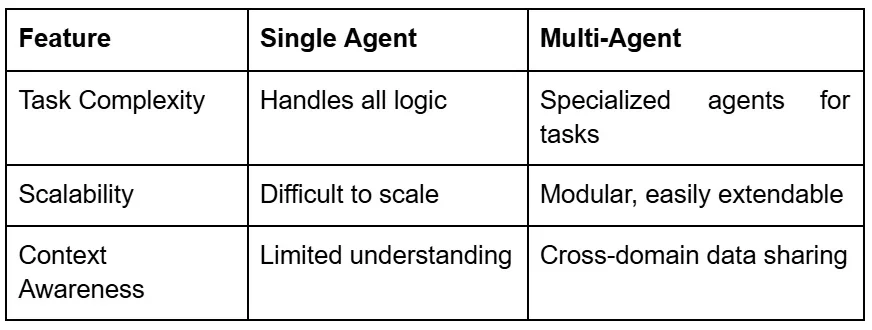 Example: AI-Driven Survey System
- Agent A: Analyzes responses and detects sentiment.
- Agent B: Generates relevant follow-up questions.
- Agent C: Validates responses and ensures logical consistency.
Retrieval-Augmented Generation (RAG) for Context Awareness
- RAG enhances LLMs by retrieving relevant information from external knowledge sources before generating responses.
- Helps models understand structured data (e.g., databases, vector embeddings) rather than just relying on pre-trained knowledge.
How RAG Works in Multi-Agent Systems
- A user query is pre-processed to extract keywords.
- Relevant information is fetched from structured data sources.
- The AI augments its response with retrieved data.
- The context-enriched query is sent to the AI model for final response generation.
AI Agents & Data Products for Seamless Integration
What Are Data Products?A data product is a structured, reusable dataset that provides domain-specific knowledge. It acts as a bridge between AI applications and business functions.Data Products in a Business Workflow- Marketing Data Product: Tracks ad engagement and audience reach.
- Supply Chain Data Product: Monitors delivery times, and inventory levels.
- Sales Data Product: Provides revenue impact analysis.
- AI Agents handle specialized tasks within workflows.
- RAG fetches additional context for accurate AI responses.
- Data Products provide a structured way to access and share business data across different AI applications.
- Better Decision-Making: AI models process relevant business data instead of generic responses.
- Cross-Domain Intelligence: AI applications can connect information across multiple domains.\
- Scalability: Modular AI agent architecture allows easy system expansion.