
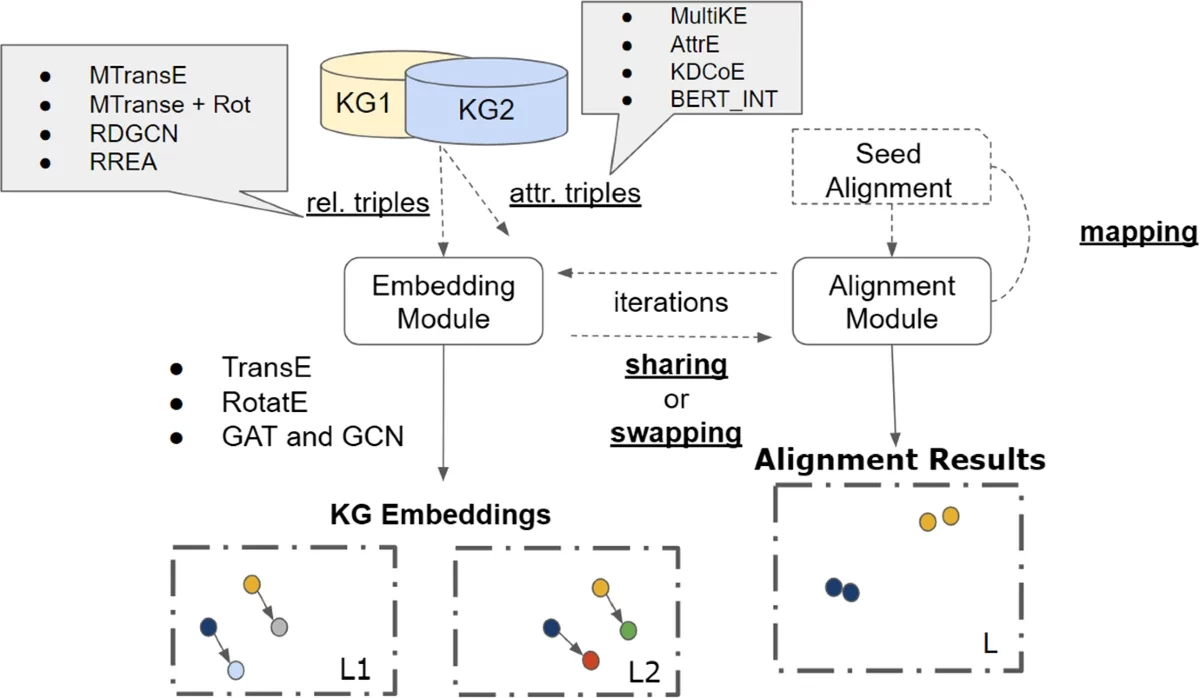
 Knowledge Graphs (KGs) play a crucial role in applications such as search engines, recommendations, and AI-driven assistants. However, integrating multiple KGs requires entity alignment (EA) identifying and linking entities that represent the same real-world objects across different graphs. Embedding-based methods have emerged as an effective solution by representing entities as vectors in a shared space, making alignment more efficient.This article summarizes key embedding-based EA techniques, including relation-based, attribute-based, and hybrid models.
Methods for Entity Alignment
1. Relation-Based MethodsThese methods use the structural relationships between entities to generate embeddings.MTransE (Multi-Translation Embedding)- Extends TransE, which models relations as vector translations:
- h+r≈t
- MTransE aligns entities across KGs by learning transformation functions:
- Distance-based: Minimizes vector distances between aligned entities.
- Translation vectors: Maps entity vectors from one KG to another.
- Linear transformation: Uses matrix-based transformation.
- Enhances MTransE by replacing TransE with RotatE, which models relations as rotations in a complex space:
- t=h o r
- RotatE can model symmetry, inversion, and composition.
- Negative sampling improves discriminative power.
- Uses Graph Convolutional Networks (GCNs) to aggregate multi-hop structural information.
- Employs a dual-graph architecture:
- Primal graph: Entity-to-entity relations.
- Dual graph: Relation-to-relation interactions.
- Attention mechanism filters relevant relationships.
- Introduces a relational reflection mechanism, learning relation-specific transformations.
- Uses orthogonal transformation matrices to preserve entity structure.
- Integrates Graph Attention Networks (GATs) for dynamic weighting of relations.
Evaluation & Findings
Evaluate these methods using:- Effectiveness Metrics: Precision, Recall, F1-score.
- Efficiency Metrics: Computation time and scalability.
- Statistical Analysis: Friedman & Nemenyi tests to compare methods.
Key Insights
- Relation-based methods (MTransE, RotatE) perform well on dense KGs but struggle with sparse attributes.
- GNN-based methods (RDGCN) leverage structure better but require more training data.
- Hybrid methods (RREA) achieve the best performance by combining structure and attribute signals.