
Agentic AI represents a cutting-edge approach where multiple agents collaborate to achieve goals within both digital and physical environments. These agents are equipped with components that allow them to perceive, reason, plan, and act autonomously, ensuring effective problem-solving and adaptability.
Key Components of Agentic AI
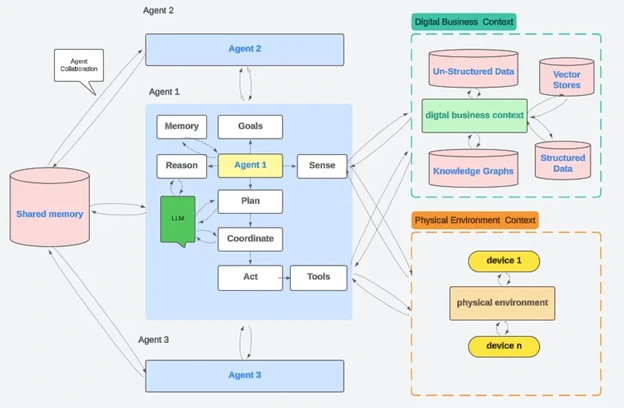
- Agents
Agents operate autonomously and interact with their environment to achieve specific objectives. Each agent has the following components:
- Memory: Stores past experiences and knowledge.
- Goals: Objectives the agent aims to achieve.
- Sense: Collects data from the environment (e.g., IoT devices, databases).
- Reason: Processes data and leverages language models (LLMs) for understanding and inference.
- Plan: Develop action strategies based on reasoning.
- Coordinate: Collaborates with other agents through shared memory for alignment.Agents Agents operate autonomously and interact with their environment to achieve specific objectives. Each agent has the following components:
- Shared Memory A central repository for agents to exchange knowledge, goals, and plans. This ensures effective collaboration and decision-making.
Types of Data Used
- Unstructured Data: Raw text, images, etc.
- Vector Stores: Embeddings for efficient similarity searches.
- Structured Data: Organized databases.
- Knowledge Graphs: Semantic networks connecting entities and relationships.
Operating Contexts
- Digital Business Context Agents interact with digital data such as vector stores, knowledge graphs, and structured databases
- Physical Environment Context Agents interface with devices like sensors and actuators to perform real-world tasks.
How Agentic AI Works
- Sensing: Collecting data from the environment.
- Reasoning: Using memory and LLMs to analyze data.
- Planning: Developing strategies to meet goals.
- Coordination: Sharing insights and aligning actions with other agents.
- Acting: Implementing the planned actions.
- Learning: Updating knowledge based on outcomes for continuous improvement.
Key Features of Agentic AI
- Modularity: Easily add or remove agents as needed.
- Scalability: Handles multiple agents and data sources efficiently.
- Adaptability: Learns from experience to improve performance.
- Multimodal Interaction: Operates across digital and physical contexts.
- Collaboration: Shared memory fosters teamwork among agents.
Technical Considerations
- Efficient data processing for structured and unstructured formats.
- Robust LLM integration for reasoning.
- Effective communication between agents using shared memory.
- Scalable architecture for complex environments.