Variational Autoencoders (VAEs) are powerful tools for generative modeling, allowing us to generate new samples similar to a given dataset. Unlike traditional autoencoders, VAEs learn probabilistic relationships between input data and latent space representations, enabling efficient reconstruction and generation. Here’s a simplified breakdown of how VAEs work and their practical implementation.
VAEs are generative models designed to produce new samples similar to the input data. They achieve this by:
What are VAEs?
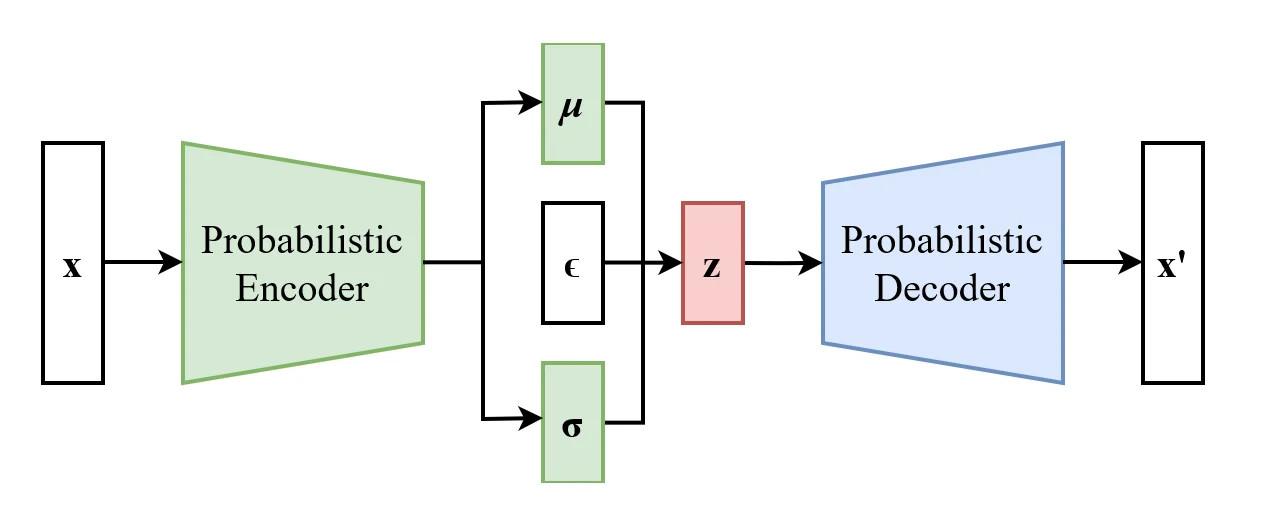
- Encoding input data into a latent space with a probabilistic distribution.
- Decoding sampled latent representations back into the input space to reconstruct or generate new samples.
Key Components of VAEs
- Input Distribution (Evidence): This represents the dataset we want to model.
- Latent Space (Prior): A multivariate Gaussian distribution assumed to represent the compressed data.
- Posterior Distribution: Describes the mapping between input data and the latent space.
- Likelihood: Models the probability of reconstructing the input from the latent space.
How VAEs Work
- Encoder: Learns mean (μ) and standard deviation (σ) for the latent space distribution from the input data.
- Reparameterization Trick: Samples from the learned posterior distribution (using μ and σ) to create latent representations while enabling backpropagation.
- Decoder: Reconstructs the input data from the sampled latent representations.
Training Objective
The VAE training objective is to:- Minimize reconstruction loss (e.g., mean squared error) to ensure accurate input reconstruction.
- Minimize Kullback-Leibler (KL) divergence to align the learned posterior distribution with the assumed prior.
Practical Implementation Using MNIST
Here’s how to implement a VAE in Python using PyTorch and the MNIST dataset:- Dataset Preparation:
- Load the MNIST dataset and split it into training, validation, and testing sets.
- Normalize the data for consistent processing.
- Define Encoder:
- Maps input images to latent space parameters (μ and σ).
- Define Decoder:
- Maps latent representations back to reconstructed images.
- Reparameterization:
- Use the formula z=μ+σ⋅ϵz = \mu + \sigma \cdot \epsilonz=μ+σ⋅ϵ (where ϵ\epsilonϵ is random noise) to sample latent representations.
- Loss Function:
- Combine reconstruction loss and KL divergence to train the VAE.
- Training:
- Optimize parameters to minimize ELBO using gradient descent.
Example: Generating Digits
After training the VAE, you can generate new digits by:- Sampling random latent representations from the prior (Gaussian distribution).
- Passing these samples through the decoder to create new images.